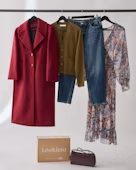
Do you stick to black for fear of clashing shades? Break the habit and add colour to your life! Choose three different tones to star in the three key parts of your outfit.

What is the three-colour rule, or the 60-30-10 rule?
The 3-colour rule is a simple yet brilliant way to harmonise any look. The idea: limit yourself to three main colours and spread them out using the 60-30-10 principle.
The 60-30-10 rule or principle
60 % – the dominant colour, covering most of your silhouette (trousers, dress or main jacket).
30 % – the secondary shade that supports the first; pick it a touch lighter or darker (think blazer, skirt, cardigan).
10 % – the accent hue, your flash of brilliance. Keep it for accessories: shoes, bag, jewellery, scarf…
The colour wheel or chromatic circle
The 3-colour rule links directly to the colour wheel, as both tools rely on colour theory to build outfits that feel harmonious and balanced.
The chromatic circle is a visual map of the spectrum, arranged into primary colours (red, blue and yellow), secondary shades (green, orange and violet) and tertiary blends created from the two groups. Use it as your compass and you can apply the three-colour rule in countless ways, guaranteeing coordinated, eye-pleasing combinations every time.
How to combine three colours without losing your cool
Mixing three shades might sound daunting, but with a few tricks and a dash of practice you’ll create the most balanced, harmonious and stylish outfits you’ve ever seen.
The secret? Choose your colours smartly and spread them so the look never feels overloaded.
Choose a neutral base — white, black, grey, beige or camel — for your 60% piece. That anchor lets you weave in one vibrant shade and one accent colour while the neutral keeps everything balanced and adds a quietly chic finish.
Have fun with tonal shifts or textures: different blues, for instance, or a mix of dark-wash denim, a sky-blue satin blouse and a navy patent bag. Accessories are the quickest way to drop in that accent hue and stop the look feeling flat.
Less really is more! Working with three colours doesn’t mean they all have to shout. If one shade is ultra-bold (scarlet or sunshine yellow, say), rein it in with softer neutrals elsewhere.
How to apply the 3-colour rule to your wardrobe
Time for practice! Here’s inspiration to mix colours for any setting, season or mood. The three-colour rule lets you play with every shade without overloading the look. Let’s build outfits that are balanced and bursting with style.
Real-life 60-30-10 examples – office, casual & evening
For the office, choose a polished palette: start with a neutral base—grey, black, white or brown—layer in a secondary shade (any blue is a boardroom winner) and add a single eye-catching accent through accessories or trim, such as a statement bag or standout shoes.
For a casual look, keep things relaxed: lead with a light main tone like blue (easy with great jeans), bring in a secondary neutral such as white or beige, then inject a lively accent in mustard-coloured accessories.
When night falls, dare to dazzle. Black makes the perfect elegant foundation; add a secondary splash of scarlet or burgundy and crown the outfit with a final metallic note—gold or silver for instant glamour.
Office look:
60%: beige trench coat.
30%: black trouser suit.
10%: blue striped blouse.
Finish with accessories that echo the palette.
Daytime casual look:
60%: blue denim jeans.
30%: white or beige top.
10%: mustard shoes.
Evening look:
60%: black blazer + top.
30%: burgundy skirt.
10%: gold clutch.
How to apply the three-colour rule by season
The key to tailoring the three-colour rule to every season is to play with the shades each one naturally suggests.
Spring – Fresh, gentle tones such as pink, mint green or lavender make a lovely base. Layer in a mid-tone, say off-white or pale blue, then add a perkier accent like coral or pastel yellow.
Summer – Warmer, livelier hues take centre stage. Begin with a clean base of white or beige, bring in a secondary turquoise or orange, and crown the look with a zingy accent such as bright red or emerald green.
Autumn – Earthy colours are the clear winners. Go for a warm base like brown or mustard, add a secondary burgundy or olive, and lift everything with toasty accents in gold or rich wine.
Winter – Cool, deep shades rule the season. Anchor your outfit with charcoal grey or black, introduce a secondary navy or forest green, and finish with a metallic accent — silver or pewter for an icy, polished touch.
Common mistakes when you use more than 3 colours
Fashion isn’t carved in stone; it’s a brilliant way to show off your personal style. That said, piling on too many shades can leave you looking busy or visually overloaded. Watch out for these classic slip-ups:
Not considering the context
Where you are and what you’re doing matter. Too many bright, attention-grabbing colours at a formal or professional event can feel out of place, even unprofessional. Sometimes less really is more.
Fix: In office or dress-code situations, lean on neutrals and keep vivid colours for accents. For casual days or parties, play more freely with punchy tones.
Forgetting texture and pattern
Mixing several colours and lots of prints or fabrics is another common mis-step. Competing patterns can drown out any sense of colour balance.
Fix: If you’re wearing a statement print (stripes, florals, you name it), let it take centre stage on a single hero piece—say a blouse or dress—and team it with solid hues elsewhere to keep the look coherent.
Not adapting colours to the season
Bright neons in mid-winter or very dark shades in spring can clash with the mood and light of the season, creating a visual disconnect.Fix: Let the weather guide you: fresh, lively hues for spring and summer; warmer, more muted tones for autumn and winter.
Bonus: the ‘sandwich rule’ to finish your outfits
Ever heard of the sandwich rule? No, it’s not a kitchen tip. Think of your outfit like a sandwich: top layer, filling, bottom layer. The idea is to frame your look with matching colours at the top and bottom, while the middle carries your main hue, keeping everything perfectly balanced.

Practical example of the sandwich rule
- Upper piece (“top slice"): a black top. You can add a layer that complements your base tone—say a coat or jacket—to frame your face and shoulders.
- Center (“filling”): an emerald-green skirt. This is the zone that carries your hero colour: it should pop, yet still respect the balance you’ve set with the upper and lower layers.
- Lower piece (“bottom slice"): black boots. They mirror the top layer, creating visual cohesion and balancing the whole look.
Expert tips from Lookiero
When it comes to getting dressed — and, let’s be honest, to life in general — fortune favours the bold. We know a little guidance makes everything smoother, so at Lookiero we’re on a mission to help every woman feel unique and utterly confident in her own skin. From the comfort of your sofa, our stylists hand-pick pieces that match your style, shape and pace of life, so you feel incredible every single day. Order your box now and enjoy fuss-free fashion from here on out.